
West Coast flowers
People come from all over the world to witness the spring flower phenomenon on display in the Western and Northern Cape, and many prefer to start their quest to find the most breathtaking blooms in the West Coast National Park.
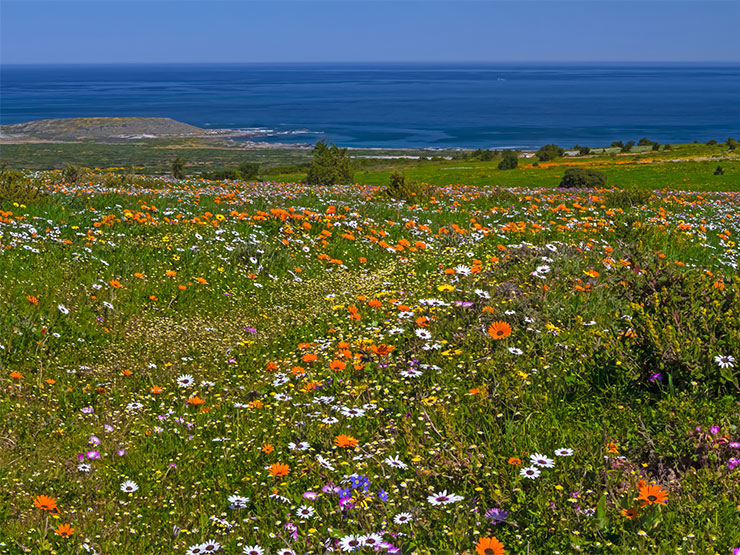
The Postberg section has the best flower displays. You can also do the two-day Postberg Hike or the one-day Steenbok Trail, and stay at the campsite inside the reserve. It’s not for novices, as the daily hikes range from 12km to 15km, and you have to bring your own camping equipment and food.
Head further north, and experience spring in the Cederberg in much greater comfort at Bushman’s Kloof Wilderness Reserve. Voted third in the 2016 Conde Nast Traveller Readers’ Choice Awards — Top Resorts in Africa, you can experience luxury in a rocky landscape that, come spring, reveals swathes of colour. See animals endemic to the area, like Cape mountain zebra, bontebok and ostrich, wander through the flowers, and experience guided tours to magnificent San rock art sites.
Driving over mountain passes on the red earth roads of the Cederberg contrasts with the dusty plains of Namaqualand much further north. This semi-arid wilderness is where the real spring flower shows begin. Good rains transform the landscape into a rainbow of Namaqua daisies. The Namaqua region is a biodiversity hotspot, and boasts the richest succulent flora on earth, like vygies (mesembryanthemums) with their colourful luminosity. Namaqualand encompasses wide distances, from the breezy Atlantic Ocean all the way inland to Pofadder, and from the Orange River in the north to Garies in the south, and the Hantam Karoo around Calvinia. To ensure the best self-drive spring flower tour, steer a course around this Northern Cape region, also taking in Springbok, Kamieskroon and Port Nolloth.
Namaqua National Park is situated in a semi-desert area, and has some of the richest bulb flora on earth. Millions of years of adaptation have created unimaginable diversity and one of the most spectacular metamorphoses in the world, where the entire landscape bursts into bloom. Add to this some thousand plant species found only here, the distinctive silhouette of quiver trees, massive granite outcrops and snowfalls of quartz, and you have a landscape like no other. At night, the stars come out, and the lack of light pollution provides a stargazing extravaganza.
Included in the wildflower route is the remote Richtersveld National Park. It is a spellbinding mountain desert with a constantly changing landscape of boulders, dunes, rocky mountain peaks, hazy plateaux and the fast-flowing Orange River. Contrary to appearance, this region, dampened by far-reaching sea mists, has a recorded 300 different plant species in one square kilometre. Many reveal themselves in spring, and demonstrate in part why this has been declared a World Heritage Site. Campsites must be booked in advance, through SANParks.
Seeing flowers blooming across great expanses of the countryside depends, of course, on whether the right amounts of rain and sun have satisfied the thirsty earth and stimulated the sudden growth of some 3 500 different plant species, and whether you happen to be in the right place at the right time. Keeping in contact with local tourist offices is the best way to get your timing right.
The information contained in this article is of a general nature and intended for information purposes only.
© Concept Publishing CC 2023