
The Sport of Kings
Eight riders on horseback thundering across a park the size of 12 rugby fields, chasing a small white ball, is exhilarating to behold.
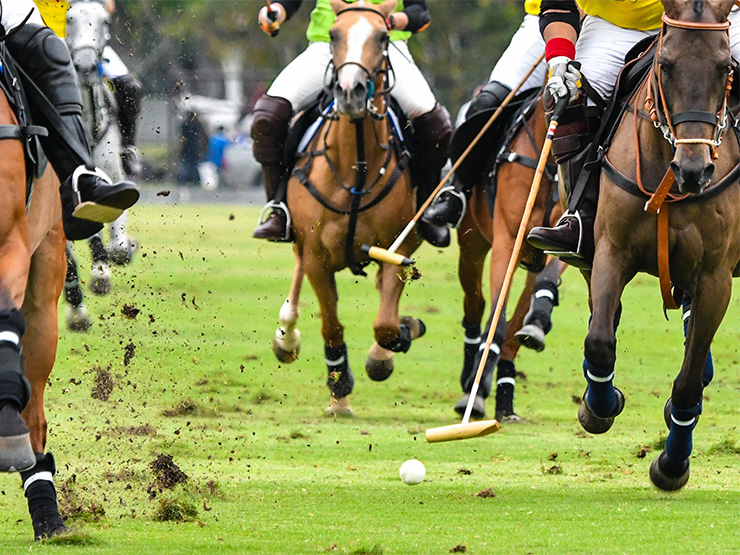
The excitement in the air is palpable and, in a Covid-free world, draws large crowds who watch the incredible horsemanship on display. There’s no room on the field for the faint-hearted – the Sport of Kings requires nerves of steel and the stamina of a Spartan.
Originally a training game for the Persian cavalry in the 6th century BC, polo was played by elite units such as the king’s guard. As many as a hundred of these warlike tribesmen competed on each side in what was considered a miniature battle.
Eventually, polo became the national sport of Persia, now Iran, and was played extensively by the nobility, from where it spread to Arabia and Asia. In the 13th century, polo was introduced to India, where in the 1830s it was taken up by the British tea planters in Assam. The first South African polo tournament was held in King William’s Town in 1894. South Africa now has around 40 clubs and about 450 players.
A fast and potentially dangerous game, the rules of polo are aimed at keeping both players and ponies safe. Rules forbid players from crossing the ‘line of the ball’ thus preventing potentially fatal, high-speed collisions. Control of the game can be regained by riding another player off the ball, which is done by pitting ponies and riders shoulder to shoulder against each other. Four horsemen per team each have a specific role, ranging from offence to defence, and the aim is to score as many goals as possible against the opposition in six chukkas. A chukka lasts seven and a half minutes, and they are separated by a four-minute break to change ponies.
The mounts, traditionally called polo ponies, are actually full-grown horses, picked for their strength, stamina, agility and temperament. Each senior high-handicap player needs a string of about 12 ponies to play high-goal polo. The ponies are trained to respond to single-hand riding and take most of their cues from the rider’s leg commands.
One of the reasons polo is considered to be dangerous is that the players wear very little protection. Helmet, boots, kneepads and, in some cases, protective glasses, coupled with a mallet commensurate with the pony’s height are all that these fearless riders don before heading out to do battle. Kitting out 12 ponies with the necessary tack and transporting them around the country is one of the things that ensures polo remains associated with the wealthy.
The polo spirit and passionate enthusiasm of players and followers are kept alive by the Provincial Championships played throughout the season. These tournaments facilitate the selection of players for the Inter-Provincial Tournament, during which the South African team is chosen.
Bridget MacDuff of the SA Polo BMW International Series says polo offers the perfect surroundings for corporate functions. “If you are an invited guest in any corporate marquee or picnic site, the dress code is smart, and people really do enjoy immersing themselves in the polo environment.” With the highest concentration of the A/B income group of any event in the country, a great deal of business is conducted on the side lines. Under the current Covid-related restrictions, spectators are not allowed at tournaments.
If your interest has been piqued and you are keen to attend a match, as and when restrictions allow, you can find more information by browsing to www.sapolo.co.za/match-centre/fixtures. While polo is a small sport in South Africa in terms of the numbers of players involved, the International Series attracted upwards of ten thousand spectators in previous years.
Each province in South Africa has its own polo clubs whose members thoroughly enjoy any opportunity to share their passion with newcomers. There is also the phenomenon of polo tourism where, at a number of luxury locations around the country, newcomers to the game can experience firsthand what it is like to be part of the polo community and play the Sport of Kings. To find out more about this exhilarating sport, visit www.sapolo.co.za
The information contained in this article is of a general nature and intended for information purposes only.
© Copyright Concept Publishing CC 2021