
The dangers of emotional investing
We all have instinctive responses to choices we face. These intrinsic behavioural patterns can have a profound effect on our financial decision-making and can ultimately determine whether we achieve our financial goals.

According to research conducted by Barclays Wealth and Investment Management, the innate need for emotional comfort is estimated to cost the average investor around 3–4% in returns on an annual basis. This loss of returns is partly due to what is known as ‘the behaviour gap.’ The behaviour gap explains the difference in what our returns would have been if we were to stick to sensible investment rules and actual returns that are determined by our short-term decision-making, mostly based on fulfilling our emotional needs. In times of market flux and uncertainty, irrespective of whether markets are rising or falling, we often make incorrect investment decisions, and end up buying high and selling low.
The cycle of emotions that investors experience that can influence their investment returns is illustrated by the graphic below. These emotions often have no correlation to market movements, and can lead to trade-offs between short-term emotional comfort and long-term investment returns. Rising markets often lead to excitement, fear of ‘losing out’ and an emotional need to invest more, resulting in investors buying shares when prices are high. At the other end of the scale, falling markets can lead to fear of loss and panic, and can cause investors to sell their shares when prices are low.
Markets often overreact on both the upside and the downside. Whatever the market reaction, it is important that investors stick to their individual investment strategy. It is understandable that investors are concerned when markets fall and start to question their investments. What an investor doesn’t want to do, however, is to make rash short-term investment decisions that have negative long-term wealth consequences.
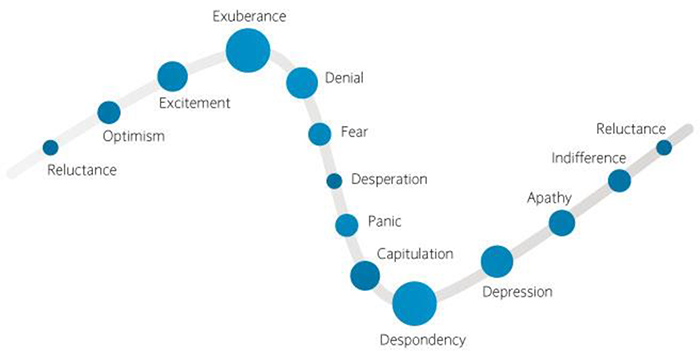
It is clear from the representation above that the emotional reaction to investing begins and ends with a reluctance to invest, which Barclays Capital describes as “an emotional and costly base state experienced by most investors.” Your reactions to the different emotional investment cycles are determined by your financial personality. Barclays Wealth and Investment Management states that the average investor loses 4-5% in investment returns each year by leaving their capital in cash, rather than investing it in a diversified investment portfolio. Fulfilling our emotional need to avoid loss by not risking our wealth by investing it is the most basic trade-off between comfort and wealth creation and is potentially a very costly emotional response. A reluctance to invest can lead to an investor only deciding to invest after a sustained period of market growth, leaving him open to the negative effects of buying when prices are high, i.e. lower returns and increased anxiety over the performance of his share portfolio.
To facilitate the creation of the ideal investment strategy for an investor’s financial personality, a financial adviser should have a clear understanding of behavioural finance and how it affects investment decisions. Behavioural finance uses a combination of psychology and financial theory to understand the connection between markets, emotions, personality and reason. To determine the best combination of high-risk, high-reward and low-risk, low-reward investments suited to a specific investor, the first step would be to determine an investor’s tolerance to risk. Knowing the investor’s risk tolerance will enable a financial adviser to build an investment portfolio that achieves the best possible returns relative to the stress and anxiety, inherent to the investment process, with which an investor is comfortable. Higher risk tolerance indicates an ability to cope with a higher-risk, higher-return portfolio, while low risk tolerance would lend itself to a lower-risk, lower-return solution.
Understanding your financial personality and risk-tolerance is the first step in the process of creating a financial strategy that will assist you in reaching your financial goals. Once you understand your natural responses to financial decisions and their possible impact on your financial well-being, you and your financial adviser can start building your investment portfolio in a way that reflects your personal comfort levels and maximises your potential for achieving financial success.
The information contained in this article is of a general nature and intended for information purposes only. It is neither to be construed as financial advice nor to be regarded as a definitive analysis of any financial, legal or other issue. Individuals must not rely on this information to make a financial or investment decision. Before making any decision, we recommend you consult your financial planner/adviser to take into account your particular investment objectives, financial situation and individual needs.
© Concept Publishing CC 2024