
Going sailing
Summer is here, and many aspiring sailors will get their first chance to go out on the water. Adhering to a few helpful guidelines will go a long way to ensuring that your maiden voyage is the first of many.
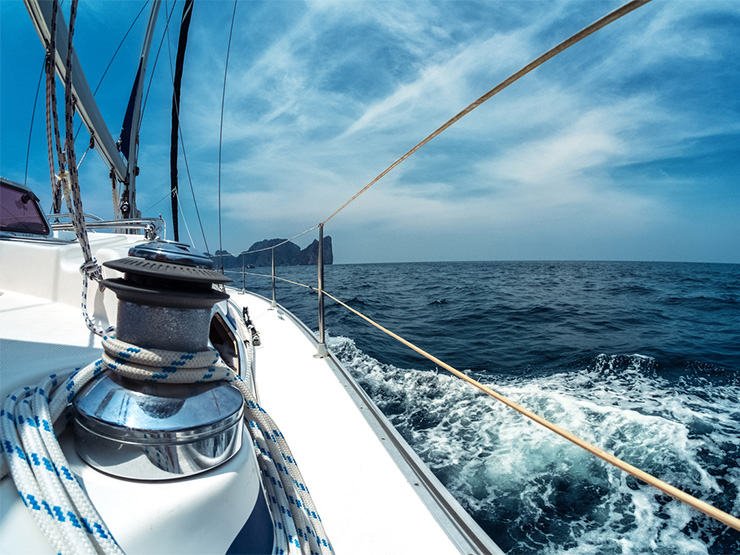
Sailing is a sport to be taken seriously, even if just participating for leisure. The water is no place to take risks with your safety, so anyone taking a craft out needs to have had proper instruction and be competent on the water.
Setting sail
Choose a day with good sailing weather. Good sailing weather means fairly calm seas, sunshine and light winds. It can get cold on the open water, so dress appropriately. In addition to warm clothing, you are advised to bring non-marking, soft shoes, a waterproof jacket, sunglasses with a string tie, a cap or hat (also equipped with a string tie), sunscreen, a packed lunch and something (non-alcoholic) to drink.
Types of sailing boats
There are two main categories of sailing boats:
- Keel boats, where stability on the water is obtained by means of a weighted keel placed under a buoyant hull. Seagoing yachts are mostly keel boats.
- Dinghies, the balance of which is regulated by weight of the crew. These rather small boats are ideal for lake sailing.
A small responsive craft will ensure that you can feel the way the wind and waves interact with the boat and will make it easier to understand the dynamics of sailing.
Safety
Watch out for the boom, which is the big, heavy bar at the foot of the main sail. The boom swings across the boat when the boat is manoeuvred, and it can injure you or knock you overboard. A combination of common-sense safety and good sail-handling will keep you and other passengers safe from injury.
Do your research thoroughly, and ensure that you go out on the boat with a properly qualified and experienced instructor. This will mean the difference between a frustrating, unfulfilling experience and a safe, fun, highly educational outing.
Walking the talk
Learning basic sailing terms such as tack and gybe, the difference between port and starboard, and the points-of-sail will enhance your first sailing experience and will make it easier for you to contribute to the sailing of the boat on the day.
The terminology used when describing various parts of the boat includes the following:
The hull and centre board
The hull allows the boat to float. Because of its long, narrow and symmetrical shape, it moves most easily in a forward direction. The centre board is a ‘vertical wing’ in the middle of the hull which improves this tendency towards forward motion and reduces sideways movement to a minimum.
The rigging
The rigging comprises the support and control cables, wires and ropes – all the cordage that is needed to keep up the mast and regulate the sails.
Mast, boom and main sail
The vertical mast supports a horizontal boom which can swivel from one side of the boat to the other. The main sail is held between these two. In order to control the direction of the main sail, a rope called the main sheet is attached to the end of the boom. Take note that a sheet is always a rope, never a sail.
The jib
The jib– a triangular sail – is stretched along a wire running from the top of the mast to the front of the boat. Jib sheets at the free angle of the triangle control this sail.
The helm or tiller
The helm or the tiller is the device which makes it possible to steer the boat. It is attached to a streamlined vertical board plunged in the water, called a rudder which swivels on a vertical axis. By pushing the tiller to the left, the boat will steer to the right and vice versa. The rudder loses its effect at angles greater than about 45°.
Preparing to set sail
While you are preparing for your first sail, invest in an instructional book or download an instructional app from iTunes or the App Store.
There are sailing clubs where you can get involved in the sport of sailing in just about every region of South Africa. Booking a lesson with a training centre can be the first step in opening up a whole new world of fun and excitement, so browse to www.sailing.org.za and chart a new course!
The information contained in this article is of a general nature and intended for information purposes only.