
An introduction to skydiving
Sebastien Lenormand, who demonstrated the parachute principle in 1783, is frequently credited for the invention of the first practical parachute.
However, Leonardo Da Vinci imagined and sketched parachutes centuries earlier – and the first implemented parachute, created in 1595, was based on Da Vinci’s drawing. The official history of parachuting began in 1797 with Andre-Jacques Garnerin, who made successful parachute jumps from a hot-air balloon. In 1911, Gleb Kotelnikov invented the first knapsack parachute. Then in 1919, Leslie Irvin invented and successfully tested a parachute that the pilot could deploy when clear of the aircraft. Yet parachuting was not really considered an actual sport until after World War II.
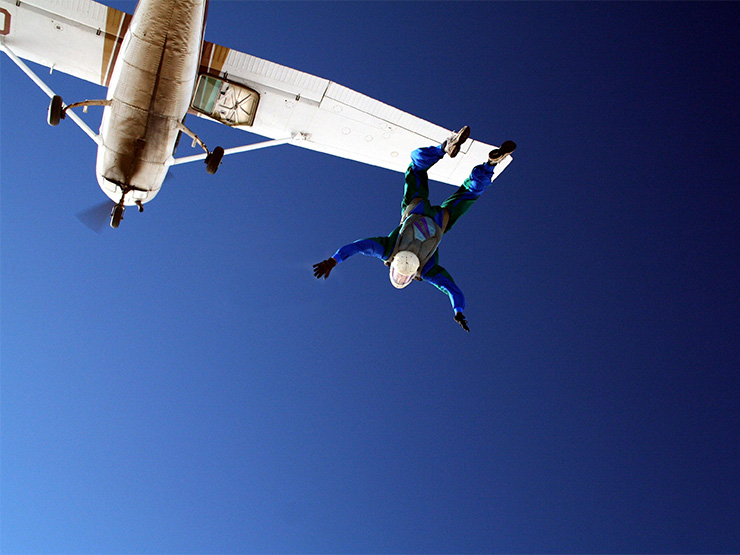
Skydiving is an exciting and liberating sport. A typical jump involves jumping out of an aircraft at approximately 13 000 feet and free-falling for a period of time before manually deploying the parachute to slow the landing down to safe speeds. Once the parachute is opened, the jumper can control the direction and speed with toggles on the end of steering lines attached to the trailing edge of the parachute.
Requirements
The Parachute Association of South Africa requires that participants carry certification, attesting to their training, experience and competence. To partake in a jump you must be at least 16 years old, with parental consent required for under-18s, and you must weigh no more than 100kg. The quickest way to experience the sport is through tandem skydiving, where you are attached to an instructor. Static line training takes about 6 hours; you exit the aircraft at 3 500 feet and the parachute deploys automatically from the static line. Accelerated Free Fall (AFF) consists of in-depth training across 10 levels, and the first AFF jump is done at 11 000 feet with two instructors. Upon graduation, a student is classified as a graduate skydiver. Parachutists should remain medically fit and acquire the required understanding of the sport and the potential hazards involved. All students are required to join PASA. First-timers are required to make a medical declaration or to produce a medical certificate stating that they are medically fit to participate.
Equipment
Clubs provide all the equipment you will need. Consider buying your own only once you progress off student status. You can buy good used equipment, acquiring a complete system and all the peripheral items in a short time and at reduced cost. Have any potential purchases examined by a qualified parachute rigger. The most important part of equipment is the main parachute; this is placed in a special sack, together with the reserve parachute, which the parachutist carries on his back with the harness. The Reserve Static Line is used to activate the reserve parachute should the main one fail, for whatever reason. An altimeter is handy, as it is used to indicate the current altitude.Helmets and goggles are optional equipment but are required when gathering high speed.
A parachute is carefully folded to ensure that it will open reliably, and the reserve parachute has to be periodically inspected and re-packed by a parachute rigger, as reserve parachutes are packed and deployed differently. They are built and tested to more exacting standards, making them more reliable than main parachutes. The primary safety advantage of a reserve chute comes from the probability of an unlikely main malfunction. Most injuries and fatalities in sport skydiving occur under a fully functional main parachute because the skydiver made an error in judgment while flying the canopy. Equipment failure rarely causes fatalities and injuries.
Learn to teach
Anyone with experience, certification and proper training can become a skydiving instructor. The process can take several months to complete, though. The Category System Basic Instructor Course (CSBI) is a one-week course covering several formal lectures on methods of instruction, basic rigging, and flying for parachuting, flight-line checking and an open book test on the Operations Manual. Weather permitting, you will carry out static line despatching. The examiners will make a collective assessment and give you a recommendation to attend a week-long exam course after any period of up to a year. The exam week begins with a written test that requires a 70% pass. You will normally do at least one formal lesson, a brief and a practical lesson, then carry out static line despatching, if the weather permits. On successful completion you will be awarded Category System Instructor status. If you want to become a Tandem or AFF Instructor, you should start by attending the CSBI course.
The information contained in this article is of a general nature and intended for information purposes only.
© Concept Publishing CC 2024