
Gyrocopters – safe, fun and versatile
They are a lot of fun to fly and, in the not-too-distant future, you might find yourself shuttling to work above the traffic in a gyrocopter.
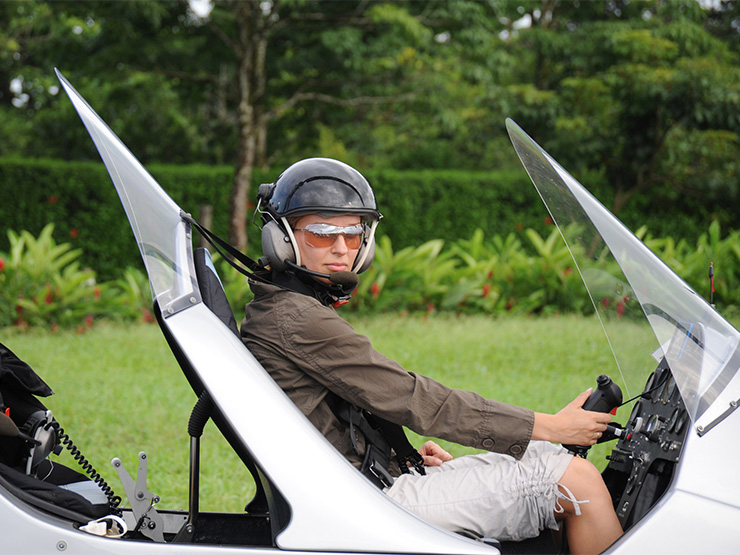
According to wired.com, two companies in particular, Skyworks Global and Jaunt Air Mobility, are developing electric air taxis. The companies say their improved gyrocopters are among the most optimized — and most readily achievable — candidates for electric aviation. “There were a few things that are really attractive about gyros in urban air mobility,” says Skyworks’ CTO Don Woodbury. “They can glide and retain full control, even in a power loss, so they don’t require things like ballistic parachutes. We think the gyrocopter can be as safe as commercial aviation, which is much safer than conventional helicopter aviation.”
A cross between a helicopter and an aeroplane, a gyrocopter is a small, rotary wing aircraft that also goes by the names gyroplane and autogyro. The term “autogyro” is used to describe the first style of gyroplanes; tractor-style gyroplanes that have a fuselage that looks like that of a conventional aircraft. While “gyrocopter” is the most commonly used name for these aircraft, the term is, in fact, a trademark of the Bensen Company. “Gyroplane” is the official term for gyrocopters in the USA.
The world’s first gyrocopter was developed by Spanish engineer and aeronautical enthusiast Juan De la Cierva. De la Cierva participated in a design competition in 1921 to develop a bomber for the Spanish military. His first design was a three-engined aircraft, which stalled and crashed during a test flight, leading him to vow to develop an aircraft that could safely fly at low airspeeds. The result of his efforts was the production of the first successful rotorcraft, which he named Autogiro, in 1923. Ironically, De la Cierva was killed in a KLM airliner crash in 1936.
Gyrocopters fly by using an aviation principle known as “autorotation”. This means that the rotor on top of the aircraft is free-spinning, while the engine at the back drives the rear propeller, pushing the aircraft forward. As the gyrocopter moves forward, air rushes underneath the blades and forces them to spin, generating lift. The angle of the blades causes them to not only provide lift, but the lift also accelerates the blades’ rotation speed until the rotor turns at a stable speed, with the drag and thrust forces in balance.
The principle of autorotation is what makes gyrocopters one of the safest types of aircraft to fly, as it enables them to remain airborne even if the engine should stall or cut out completely. Even though the aircraft’s top rotor blades will not generate enough lift on their own to keep the gyrocopter flying without the rear propeller driving the aircraft forward, they will enable the aircraft to descend safely in an emergency situation.
According to Wikipedia, there are three primary flight controls: Control stick, rudder pedals and throttle. The control stick tilts the rotor in the desired direction to provide pitch and roll control. The rudder pedals provide yaw control (turning around the aircraft’s vertical axis), and the throttle controls engine power. Unlike a helicopter, most autogyros need a runway to take off; however, they are capable of landing with a very short or no ground roll.
Due to their ease of use and flexibility, gyrocopters can be used for various purposes, including leisure flying, sight-seeing, aerial photography and game ranging. Farmers also find the aircraft particularly helpful, as it makes light work of checking on livestock, water supply and fences. While gyrocopters cannot hover like helicopters, they can fly at very slow speeds, offering the pilot and the passenger the opportunity to observe their surroundings.
Although they are relatively easy to fly and very stable, even in adverse flying conditions, flying a gyrocopter in South Africa requires training and a licence. The South African Gyroplane Association is committed to the promotion of gyroplane flying in South Africa and can be contacted by telephone on +27 (0)83 282 8792 or via their website, where you can also find information on gyroplane flying, as well as details of instructors.
Cape Gyro states that obtaining a gyrocopter pilot’s licence requires a minimum of 25 hours of dual-flying instruction and a minimum of 15 hours of solo flight, under supervision. A student pilot licence can be issued at age 16, but the licence itself requires a minimum age of 17. Other requirements are a class 4 medical, a restricted radio licence, a flight skills test and a minimum of 75% in the following theory exams: Principles of Flight, Aviation Law, Air Navigation, Aviation Meteorology, Engines and Airframes and Human Performance.
If you are looking to purchase a gyrocopter, RAF 2000 (www.rafsa.co.za) is one of the manufacturers that will sell you a kit for assembly.
The information contained in this article is of a general nature and intended for information purposes only.
© Copyright Concept Publishing CC 2021