
Fly-fishing
There is no better escape from today’s fast-paced world than enjoying the relaxing and tranquil sport of fly-fishing.
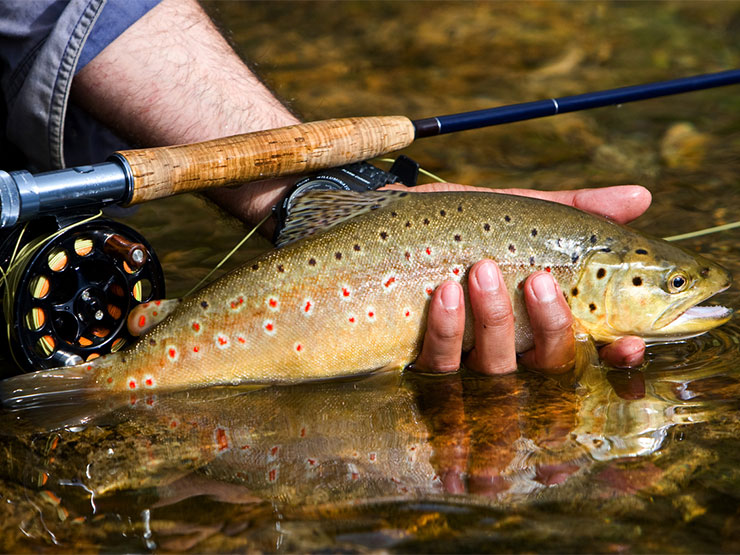
The Roman Claudius Aelianus, who lived in the second century AD, was apparently the first enthusiast to write about fly-fishing. In 1496 Dame Juliana Berners, an English nun, wrote The Treatyse of fysshynge wyth flyes. In it she described the use of artificial flies and fishing with lines made from horsehair.
South Africa has a number of excellent fly-fishing areas. Some of the most popular spots can be found in Dullstroom, Machadodorp and Waterval Boven in Mpumalanga. In the Western Cape, fly-fishing enthusiasts know that beautiful fish are to be found in the upper reaches of the Breede River, and in KwaZulu-Natal the Pongola and Drakensberg regions offer great angling.
Anglers use an artificial fly to imitate the insects that some fish prey on. Some flies float on the water, and others are partially or fully submerged. Although flies can be bought ready made, dedicated fishermen spend hours making their own from feathers, fur, hair and thread bound to a hook.
Fly-fishing is a gentle art. The aim is to land the line on the water as smoothly as possible with the least possible disturbance. The rod is much lighter than that used for other types of fishing, and the line is heavier to ensure smooth casting, which is done in a gentle forward and backward movement to ensure a properly unfurled line.
Popular fly-fishing species include trout, bass, salmon, pike, yellow fish and carp. South Africa boasts a number of farms where man-made or natural dams are stocked for fly-fishing. Most of these farms also offer luxury accommodation to cater for local and foreign tourists.
“Most fly-fishers release their catch,” says Jonathan Boulton, a well-known conservationist, writer and owner of Mavungana Fly-fishing Consultants. “Fly-fishers have a strong conservationist ethic and fish are mostly caught for consumption only if it comes from a stocked dam.”
In South Africa, the Federation of Fly-fishers (FFSA) helps to rehabilitate rivers, and educates its members about how to engage ethically with other anglers and with the environment. “We have to respect the land, plants, water, fish and other components that form part of the ecosystem,” says Garth Brook, founder member of the FFSA and author of a number of books on fly-fishing.
Ethical behaviour includes limiting the catch to prevent some species becoming endangered, avoiding the introduction of alien fish species that might upset the ecological balance in fishing waters and releasing overharvested and underweight fish.
Although the term fly-fishing conjures up images of calm, placid lakes and rivers, Brook says that interest in saltwater fishing is increasing worldwide. “Saltwater fishing poses different challenges to fishing in fresh water. Because of sea swells, more heavyweight equipment is needed. The rods and the fishing lines are heavier, and the flies are much bigger and bulkier than those used for freshwater angling.”
The information contained on this website (or in this article) is of a general nature and intended for information purposes only.
© Concept Publishing CC 2023